
Can you think of any images that ‘exist only’ for you?
We all have images which ‘exist only’ for us. The sit in photo albums and picture frames. In keyrings and wallets. They are of our loved ones both alive and dead.
What do you think about the relationship between images and viewers?
The relationship between images and viewers is of great importance particularly to photographers. Here we define that photographers are making images for others to see and that images taken by ‘lay persons’ are those which go into those items of vernacular. As photographers if we are not making images for someone other than ourselves then what is the point? The relationship between image and viewer is important due to how our viewer may read our image. What do we want to show them? Do we want our images open to their own reading? Do we want to refine their reading more closely?
Do some images ‘exist for’ us?
All images exist for someone, whether that someone is the intended someone is a point of discussion. Images of a personal nature such as a family birthday party or a wedding are intended for a very particular someone. Images created by photographers, as discussed above, are created for an intended viewer.
Do we really live in ‘Plato’s Cave’?
From the perspective of the 21st century we possibly live in multiple Plato’s caves, each with an alternate reality being played out before us.
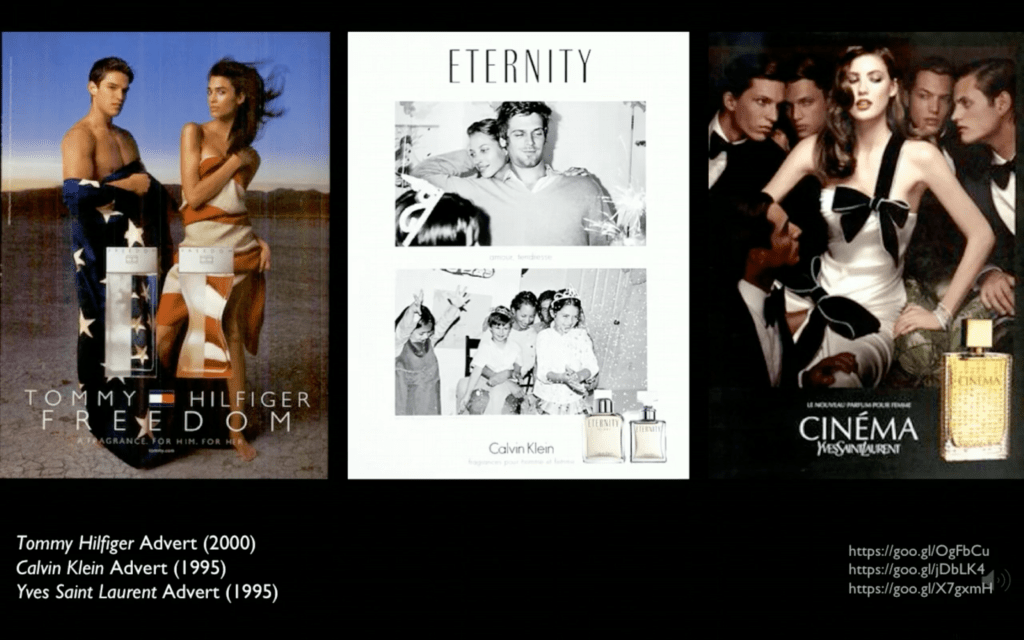
How did you read these images?
I have never had much time for fragrance adverts as they sell an ideal rather than the product. Fragrance advertising is tricky as you can nearly never present the product adequately, no one buys perfume for its ideal! They buy it for how it smells!
What is the aim of the advertiser?
The adverts attempt to portray some of the fundamentals at the base of the ‘American Dream’ with freedom and families taking pride of place. This is attempted through the symbolism of the American flag, although neither model seemed thrilled by their apparent freedom. Maybe it’s attempting to portray that the flag is actually suffocating to their freedom. The bottles for the fragrance mirror the figures in the image. With the masculine fragrance having straight strong edges while the feminine fragrance has the ‘hour glass’ shape to it.
In the advert for Eternity the attempt is to show family unity despite the US having the highest divorce and ‘broken family’ rates in the world. I read it in an entirely different way. The bottom frame show a family apparently at a party, the top frame we suppose is from the same scenario. The lower frame contains children and a couple who we presume are the parents towards the back of the image. They are partially obscured by the children. Is this to signify the pressures of children and that they come above and before your relationship? The top from is a much closer crop where we can see a couple more clearly and the crown of a childs head in the bottom left corner of the image. Is this closing in on the couple dismissive of the children in the frame? Also dismissive of the context of the frame?
Did you understand their intended message?
With reading, I understand the intended message however have my own reading of that message.
To whom might they appeal?
The images may appeal to the nationalistic American, the flag waving patriot. Both Klein and Hilfiger are American brands and so are playing upon their heritage at a time of national unrest and unity in the wake of 9/11. While the YSL perfume, YSL being a French company, carries no symbolism of patriotism or ‘Americanism’ but rather carries very clear objectification of women.
Did they appeal to you?
No
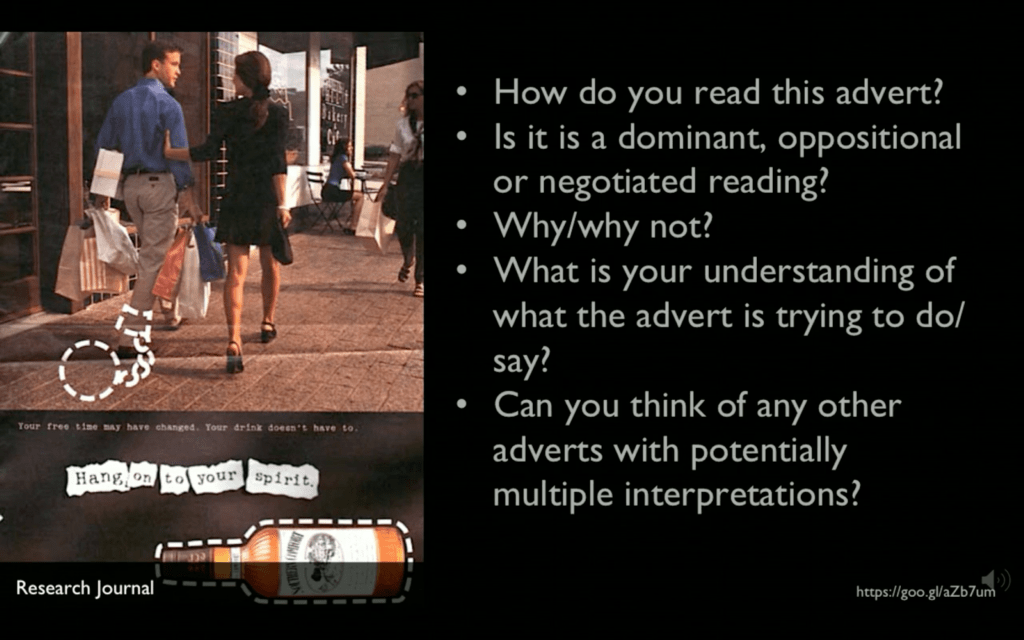
How do you read this advert?
The reading of this advert shifts depending on the presence of the lower segment. If we consider just the image on the upper two thirds of the advert we have a male, presumably in a relationship with the female. He is carrying a large amount of shopping bags. The illustration on the photograph is of a ball and chain, stereotypical of prisoners ‘of old’. The assumption of the idiom is that to marry is to obtain a ball and chain and thus be a prisoner in that relationship. You are, of course, not a prisoner, but the suppositions thereof are that the male is limited with their behaviours and actions much in the same way that a prisoner is.
If we now consider the lower third of the advert we add context with the Southern Comfort brand and this campaigns anchor of ‘hang on to your spirit’. Spirit here has two meanings, the first is directly that the beverage is an alcoholic spirit and the second being the emotional spirit one has. The assumption of the advert is that the male has lost his spirit through his possession of the ‘ball and chain’ and has made sacrifices as a result.
Is it a dominant, oppositional or negotiated reading?
My reading of this image, I feel, falls into none of these categories but rather is as objective as one can get.
Why/Why not?
As time goes on, and in line with my own teaching practice, my ability to read and interrogate images has become much more refined over the years.
What is your understanding of what the advert is trying to do/say?
As outlined in my reading, my understanding of the advert is that in the photograph the male is trapped by his ball and chain and has lost sight of his spirit and of himself. That spirit is, somehow, regained if he were to drink Southern Comfort.
Can you think of any other adverts with potentially multiple interpretations?
The advert I am giving here is the 2019 Gillette ‘We Believe’ advert. Released in a time ‘me too’ and ‘toxic masculinity’, it’s an important and crucial commentary on 21st Century culture. At the time the advert was greeted with a range of emotions and responses all of which indicating a diversity in interpretations.
There was, of course, the celebratory response with people hailing Gillette for taking a stance on these issues. This is particularly prevalent with the razor companies long term hook line of ‘The Best a Man Can Get’ and the advert going on to draw their line in the sand with regards to their responsibility and our responsibility in shaping the future.
On the flipside, the advert received a huge backlash from people, probably insecure in my opinion, feeling attacked by it. The interpretation being that the advert is an ‘attack on free speech’ and that, as the clip alludes to, ‘boys will be boys’. This interpretation cements the need for the campaign and indicative that its work is far from over.
Did you feel stereotypically positioned as a consumer of these images?
I have never really felt effected by advertising and so would struggle to answer this question personally. I can see how the stereotypes which are targeted by these adverts may be effected. The only example where advertising has had an impact on me has been with adverts for GoPro cameras, particularly their 2012 campaign. The thing about GoPro adverts is that they do not sell cameras they sell a lifestyle, an experience and an ideal.
How natural/obvious were they to you?
I feel that the positioning of stereotypes within these shown adverts are quite obvious and blatant. Advertising largely does not work on more educated minds who are able to see through the veil of disguise.
Did you experience a dominant, oppositional or negotiated reading?
At this moment I do not fully understand these three elements and don’t feel that I have experienced them here. Further reading and research will be needed to try and refine this.
What is the relationship between text and image?
The relationship between text and image is critical, particularly in advertising. The meaning of photographs are not fixed and are open to interpretation and abuse. The use of text can either confirm or alter the meaning of the image and so their relationship is intrinsic.
Can you think of any more contexts in which a shared understanding and a shared interpretation are important?
 Andrews Masters Journey