
This weeks lecture focused on and discussed three texts; The Photographers Eye by John Szarkowski, The Nature of Photographs by Stephen Shore and What is a Photograph? the show catalogue from the exhibition by the same name at the ICP in 2014.
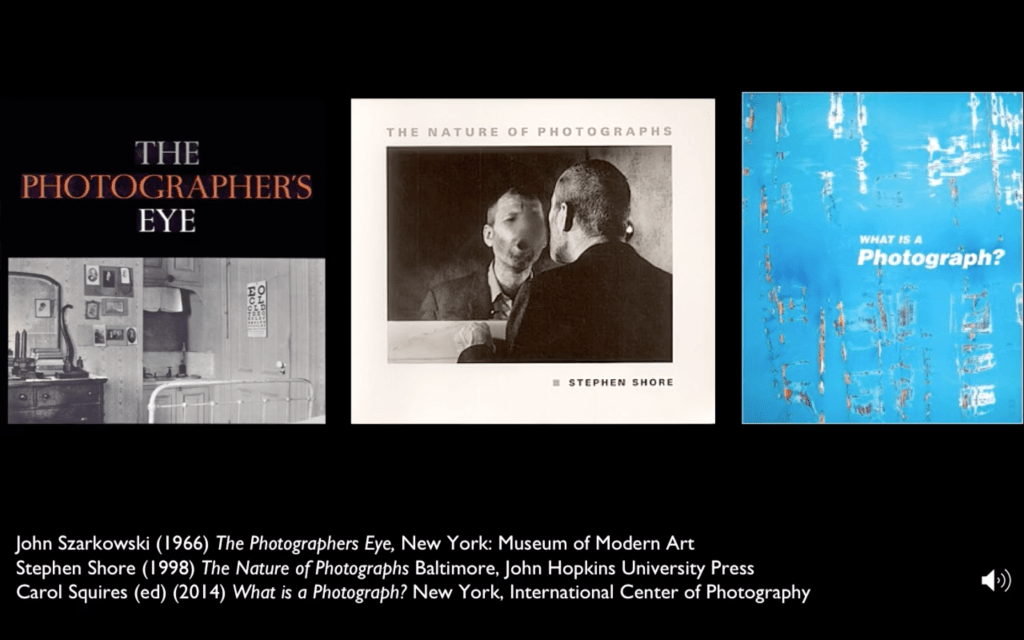
The lecture featured many extracts from the three texts, not all of which require repeating here but would possibly be useful as the course progresses. At the end of each text discussion, and at the end of the lecture, there were questions. I have brought my answers to those questions together in this post.
To preface, Szarkowskis The Photographers Eye outlined five elements which he felt were important within a photograph. The thing itself, the detail, the frame, time and the vantage point.
- Are any of szarkowskis photographic characteristics important to your own practice
All of these elements are important to all photographers practice at some point in time. Some stand as challenges or limitations, some stand as strengths or areas of exploitation
- Why?
Factors such as ‘time’ and ‘the frame’ are unescapable and stand for all photographers. Vantage points are of particular interest to me in my current practice as the positioning of the camera is central to the composition of the photographs.
- Can you add any new ones?
If I were to add an element it would be of ‘Subjective implication’. No photography is truly subjective and the prejudices and preconceived ideas that a viewer brings to your image are critical and uncontrollable.
Stephen Shore describes photographs using three elements, each of which has its own make up and composition. These being the physical level, the depictive level and the mental level. A mental level being images and depictions we see in our mind purely through our experiences and minds composition. An example could be to say ‘Eiffel tower’. If one had not visited the Eiffel tower they would still be able to mentally visualise it due to their experiences with photography.
Shore goes on to break down the depictive level in more depth. The frame, time, and focus.
- Does a photograph need to be a ‘viewed scene’?
All photographs are viewed scenes, whether the viewer is familiar with that specific view or are able to relate to and find characteristics which spring to mind when viewing a photograph.
- How do you work with the characteristics of the photograph as a constructed reality?
The vast majority of digital images I produce these days are through High Dynamic Range using Bracket exposures. This HDR process constructs a reality beyond the capabilities of a film camera, a single digital frame or even the human eye.
 Andrews Masters Journey